National Inventory

In Spain, the definition of radioactive waste is established in article 2 of Law 25/1964, from 29th April, about nuclear energy (LEN) as follows: “Radioactive waste is any material or waste product, for which there is no expected use, that contains or is contaminated with radionuclides in concentrations or levels of activity over those established by the Ministry of Ecological Transition and Demographical Challenge, with a previous report of the Nuclear Safety Council (CSN)”.

According to article 6.c) of Royal Decree 102/2014, among the contents of the GRWP there must be “An inventory of all spent nuclear fuel and radioactive waste, as well as estimates of future amounts, including from decommissioning. This inventory shall clearly indicate the siting and amount of spent nuclear fuel and radioactive waste, according to a classification that takes into account the final management scheduled for it”. Thus, the final management route is key in the classification of radioactive waste. Although there are many types of radioactive wastes, these wastes are categorized in Spain according to the management facilities authorized for a volume, radiological inventory and specific activity concentration limits, depending on the nature of the different radionuclides present. These categories are:

Radioactive waste classification

Low and Intermediate Level Waste, short-life (LILW)

Those whose activity is mainly due to the presence of radionuclides beta-gamma emitters, with a short-medium disintegration period (below 30 years) and whose content in long-life radionuclides is very low and limited. This group includes low- and intermediate-level radioactive waste (L&ILW), which are a subset of low-level radioactive waste (LLW) and, in general, have specific activities between 1 and 100 becquerels per gram, reaching up to several thousand in the case of some low-radiotoxic radionuclides or when dealing with small quantities.

Special Waste (SW)

This group includes nuclear fuel cladding, neutron sources, used intranuclear instrumentation, or replaced components from the reactor vessel system and reactor internal components, generally of a metallic nature, which, due to their radiological characteristics, are not suitable for management at the C.A. El Cabril facilities. As a long-lived and significantly active radioactive waste, its temporary and final management is planned in a similar way to that of the HLW.

High Level Waste (HLW)

Those that contain significant concentrations of long-lived alpha emitters with half-lives greater than 30 years, in significant concentrations, that generate heat due to radioactive decay, since their specific activity is high. Its main exponent is the spent nuclear fuel (SNF) discharged from nuclear reactors.

Did you know?

Radioactive isotopes tend to become stable elements, that is, they lose their radioactivity. The time a radioactive substance takes to reduce its activity to the half is called "semidesintegration period".

Origin of the radioactive wastes in Spain

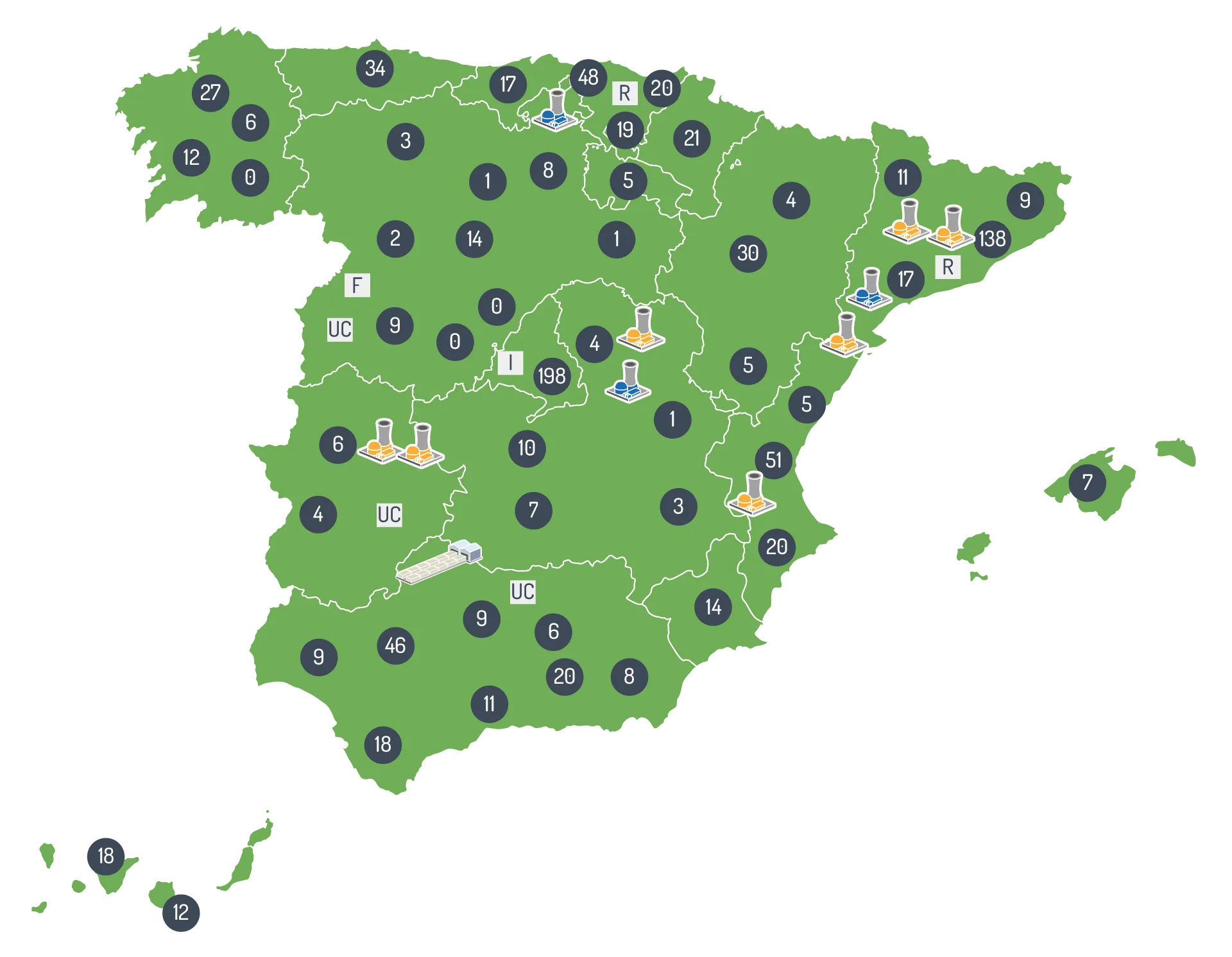
The following map shows the main radioactive waste producers in Spain.

La Coruña
27 Radioactive facilities with
technical specifications suscribed
as at 2022/09/23.

Asturias
34 Radioactive facilities with
technical specifications suscribed
as at 2022/09/23.

Cantabria
17 Radioactive facilities with
technical specifications suscribed
as at 2022/09/23.

Vizcaya
48 Radioactive facilities with
technical specifications suscribed
as at 2022/09/23.

Guipuzcoa
20 Radioactive facilities with
technical specifications suscribed
as at 2022/09/23.

Lleida
11 Radioactive facilities with
technical specifications suscribed
as at 2022/09/23.

Girona
9 Radioactive facilities with
technical specifications suscribed
as at 2022/09/23.

Lugo
6 Radioactive facilities with
technical specifications suscribed
as at 2022/09/23.

León
3 Radioactive facilities with
technical specifications suscribed
as at 2022/09/23.

Alava
19 Radioactive facilities with
technical specifications suscribed
as at 2022/09/23.

Navarra
21 Radioactive facilities with
technical specifications suscribed
as at 2022/09/23.

Barcelona
138 Radioactive facilities with
technical specifications suscribed
as at 2022/09/23.

Pontevedra
12 Radioactive facilities with
technical specifications suscribed
as at 2022/09/23.

Ourense
0 Radioactive facilities with
technical specifications suscribed
as at 2022/09/23.

Burgos
8 Radioactive facilities with
technical specifications suscribed
as at 2022/09/23.

La Rioja
5 Radioactive facilities with
technical specifications suscribed
as at 2022/09/23.

Huesca
4 Radioactive facilities with
technical specifications suscribed
as at 2022/09/23.

Palencia
1 Radioactive facilities with
technical specifications suscribed
as at 2022/09/23.

Zamora
2 Radioactive facilities with
technical specifications suscribed
as at 2022/09/23.

Valladolid
14 Radioactive facilities with
technical specifications suscribed
as at 2022/09/23.

Soria
1 Radioactive facilities with
technical specifications suscribed
as at 2022/09/23.

Zaragoza
30 Radioactive facilities with
technical specifications suscribed
as at 2022/09/23.

Tarragona
17 Radioactive facilities with
technical specifications suscribed
as at 2022/09/23.

Segovia
0 Radioactive facilities with
technical specifications suscribed
as at 2022/09/23.

Salamanca
9 Radioactive facilities with
technical specifications suscribed
as at 2022/09/23.

Ávila
0 Radioactive facilities with
technical specifications suscribed
as at 2022/09/23.

Guadalajara
4 Radioactive facilities with
technical specifications suscribed
as at 2022/09/23.

Teruel
5 Radioactive facilities with
technical specifications suscribed
as at 2022/09/23.

Castellón
5 Radioactive facilities with
technical specifications suscribed
as at 2022/09/23.

Madrid
198 Radioactive facilities with
technical specifications suscribed
as at 2022/09/23.

Cuenca
1 Radioactive facilities with
technical specifications suscribed
as at 2022/09/23.

Valencia
51 Radioactive facilities with
technical specifications suscribed
as at 2022/09/23.

Toledo
10 Radioactive facilities with
technical specifications suscribed
as at 2022/09/23.

Cáceres
6 Radioactive facilities with
technical specifications suscribed
as at 2022/09/23.

Badajoz
4 Radioactive facilities with
technical specifications suscribed
as at 2022/09/23.

Ciudad Real
7 Radioactive facilities with
technical specifications suscribed
as at 2022/09/23.

Albacete
3 Radioactive facilities with
technical specifications suscribed
as at 2022/09/23.

Alicante
20 Radioactive facilities with
technical specifications suscribed
as at 2022/09/23.

Baleares
7 Radioactive facilities with
technical specifications suscribed
as at 2022/09/23.

Huelva
9 Radioactive facilities with
technical specifications suscribed
as at 2022/09/23.

Sevilla
46 Radioactive facilities with
technical specifications suscribed
as at 2022/09/23.

Córdoba
9 Radioactive facilities with
technical specifications suscribed
as at 2022/09/23.

Jaén
6 Radioactive facilities with
technical specifications suscribed
as at 2022/09/23.

Murcia
14 Radioactive facilities with
technical specifications suscribed
as at 2022/09/23.

Cádiz
18 Radioactive facilities with
technical specifications suscribed
as at 2022/09/23.

Málaga
11 Radioactive facilities with
technical specifications suscribed
as at 2022/09/23.

Granada
20 Radioactive facilities with
technical specifications suscribed
as at 2022/09/23.

Almería
8 Radioactive facilities with
technical specifications suscribed
as at 2022/09/23.

Santa Cruz
18 Radioactive facilities with
technical specifications suscribed
as at 2022/09/23.

Las Palmas
12 Radioactive facilities with
technical specifications suscribed
as at 2022/09/23.

C.N Sta. Mª de Garoña

C.N. Ascó I y II

C.N. Ascó I y II

C.N. Trillo

C.N. Vandellós II

C.N. Almaráz I y II

C.N. Almaráz I y II

C.N. Cofrentes

Instalación nuclear Vandellós I

C.N. José Cabrera

Decommissioned research reactor: Arbi.

Barcelona
Decommissioned research
reactor: Argos

Nuclear fuel manufacturing
facility 'Juzbado' (Salamanca)

Uranium mills closured in
Saelices el Chico

Research centre

Uranium mills closured in
La Haba

El Cabril Disposal Facility for
LILW and VLLW

Uranium mills closured in
Andújar

Main producers of radioactive wastes. Currently, there are 7 reactors in operation, in 5 sites: Almaraz I and II (Cáceres), Cofrentes (Valencia), Vandellós II and Ascó I and II (Tarragona), Trillo (Guadalajara).

  • Santa María de Garoña Nuclear Power Plant (Burgos) which is currently in the dismantling phase 1.
  • José Cabrera Nuclear Power Plant (Guadalajara), which is currently in the final phase of decommissioning.
  • Vandellós I Nuclear Power Plant (Tarragona), currently in the latency phase after its partial dismantling.

El Cabril is the Spanish disposal facility for very low, low and intermediate lever radioactive waste. It is located within the minucipal area of Hornachuelos (Córdoba).

Nuclear fuel manufacturing facility “Juzbado” (Salamanca), where oxide uranium fuel elements for NPP reactors are manufactured.

Reactor JEN-1 (Ciemat, Madrid), Argos (Barcelona) and Arbi (Bilbao). These research reactors are currently dismantled, and their associated wastes have been sent to C.A. El Cabril.

Centro de Investigaciones Energéticas, Medioambientales y Tecnológicas (Ciemat), in Madrid, has a series of radioactive facilities in operation and a series of nuclear facilities already dismantled.

Uranium mills, already closured and located in Andújar (Jaén), La Haba (Badajoz) and Saelices el Chico (Salamanca).

We consider those facilities located all over the national territory that have technical-administrative specifications signed with Enresa at inventory date. According to Royal Decree 1836/1999, of 3rd December, radioactive facilities are defined as:

  • Any kind of facilities that have an ionizing radiation source.
  • Devices that produce ionizing radiation working with a potential difference over 5 kilovolts.
  • Locations, laboratories, factories and facilities that produce, use, own, treat, manipulate or store radioactive materials, except disposal facilities.

National Inventory

According to article 38 bis of the Law 25/1964, from 29th April, on Nuclear Energy (LEN), radioactive waste management in Spain, including spent fuel, and decommissioning, dismantling and closure of nuclear sites, is categorized as an essential public service entrusted to the State, being this responsibility submitted to Empresa Nacional de Residuos Radiactivos, S.A. S.M.E. (Enresa), according to the General Radioactive Waste Plan (GRWP) approved by the Government. Currently, the 7th General Plan for Radioactive Waste, approved by the Government on 27th December 2023.

Additionally, Royal Decree 102/2014, from 21st February, for a safe and responsible management of the nuclear spent fuel and the radioactive wastes, sets in its article 9, as one of Enresa’s responsibilities, the preparation and management of the National Inventory for Spent Fuel and Radioactive Wastes, which shall include wastes and spent fuel definitively disposed of, after the closure of the installation where they are allocated.

This is the reason why, in 2014, Enresa began working in a new National Inventory for Spent Fuel and Radioactive Waste, closed as at 31st December 2015. Since its creation in 1984, Enresa has developed an inventory of radioactive wastes in Spain, with the data received from all waste producers. Since then, there has been a close cooperation and an improvement on the detailed knowledge of the situation, which has allowed the elaboration of more precise strategies and management programmes.

The National Inventory is based on a series of reports, which reflect both the origin of the radioactive wastes and spent fuel, and the hypothesis considered to reach the final values for the expected wastes, according to the established uncertainties.

In the interest of transparency, Enresa acknowledges the importance of having the national inventory data publicly available in a simple and accessible way for the population.

Inventory of 31st December 2022

Within the inventory data, it is interesting to know the origin of the data and the way the information is generated.

Origin of the data for wastes generated at one date

The data for elaborating the Inventory come, mainly, from the producers of spent nuclear fuel and radioactive wastes. Enresa receives the information according to the technical-administrative specifications for accepting nuclear spent fuel and radioactive wastes, as required in article 11 of Royal Decree 102/2014.

Annually, nuclear power plants in operation prepare a preliminary program of waste generation during operation that includes:

  • Number of waste packages for each waste stream to be produced in the next 5 years of operation, and those produced during the previous year.
  • Estimates of fuel elements to be discharged in the next 10 years of operation, and the spent fuel elements generated during the previous year.

All this information sent by the waste producers is included in the Data Bases developed by Enresa to control the inventory of wastes.

In the case of wastes coming from the dismantling of nuclear power plants and other facilities, Enresa, as the company responsible of these projects (up to now in Vandellós I, Pimic/Ciemat, José Cabrera and Santa María de Garoña), has developed specific management systems in order to control the materials and wastes generated and their subsequent management. In case they are finally managed as radioactive waste, this information is turned over in the Data Bases already mentioned.

In terms of future estimates for the dismantling of Spanish nuclear facilities, Enresa has developed some studies to be able to make some forecasts on quantities, typologies and uncertainties.

For radioactive facilities, the technical-administrative specifications include the obligation of the owner to inform Enresa about the estimates of radioactive waste generation and the possible changes that may occur. For other facilities, future previsions are done from the basis of the previous experience.

The inventory of wastes generated as of 31st December 2022, is reflected in the following table:

Table that reflects the inventory of wastes generated as of 31st December 2022, during the operation and the dismantling of the NPPs (67415 m³ and 15051 m³).
Origin of the waste VLLW (m3) LILW (m3) SW (m3) HLW and SF (m3) TOTAL (m3)
Waste from operation 11.700 37.100 15 8.900 57.715
Waste from dismantling 19.600 4.000 185 --- 23.785
TOTAL 31.300 41.100 200 8.900 81.500
Wastes generated are classified as LILW, VLLW, SW and HLW and SF. By 31st December 2021, a total volume of 80,400 m³ has been generated, mainly low and intermediate level wastes and very low level wastes.

The volume given is considering the waste after disposal.

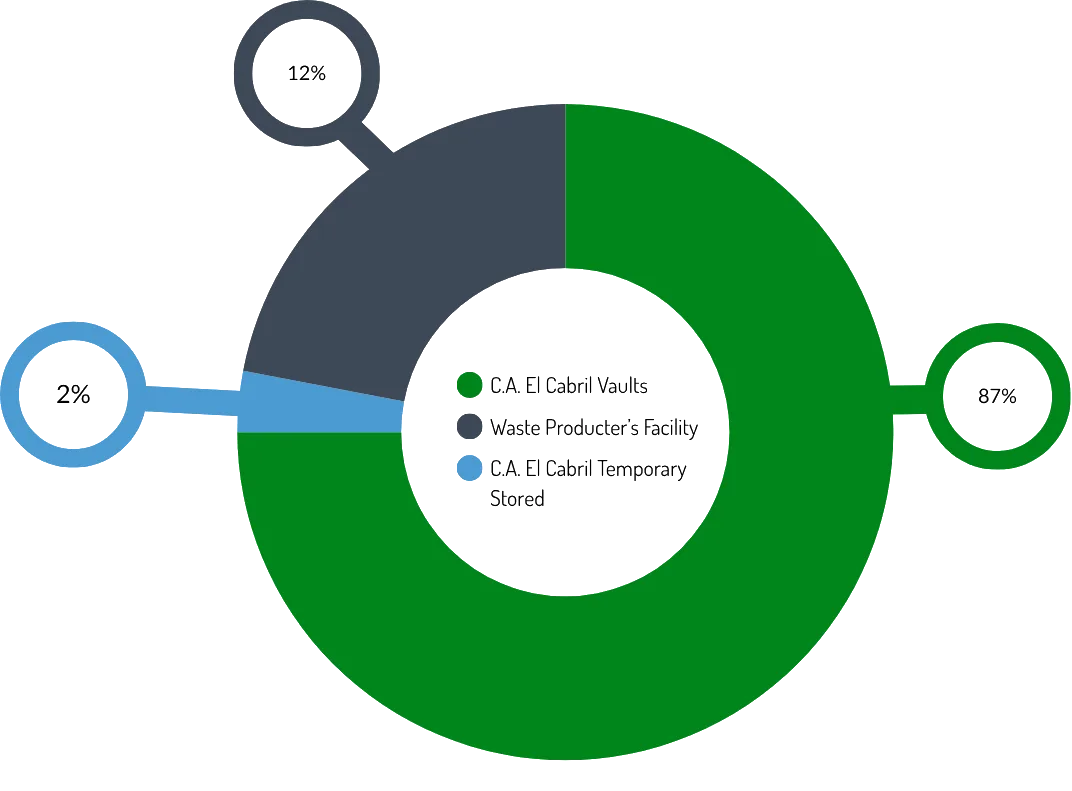
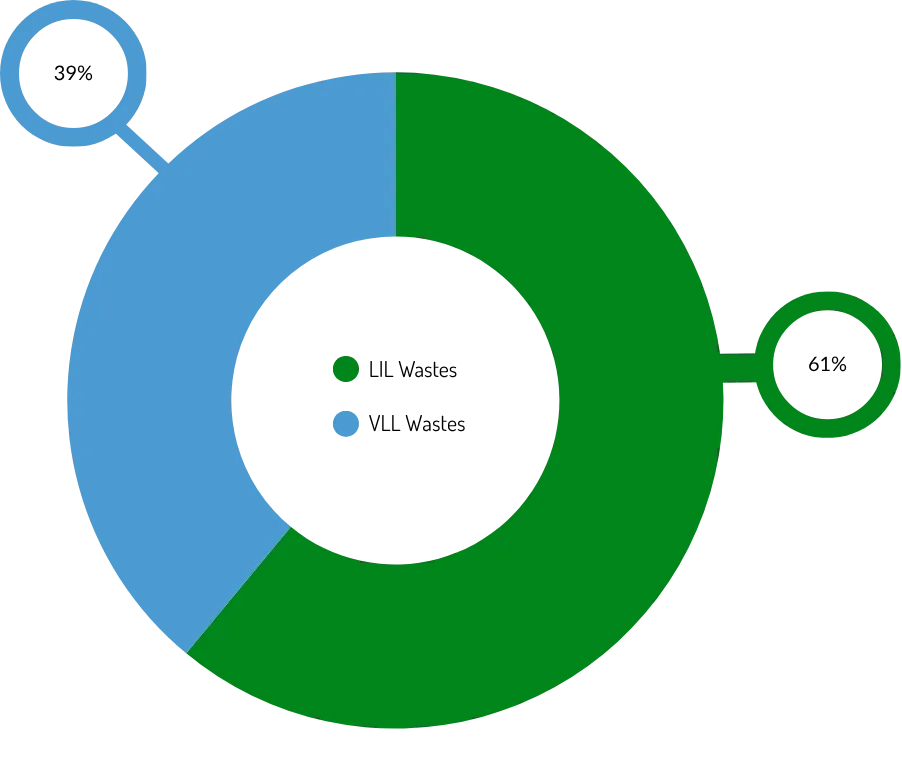
From the total amount of LILW and VLLW generated, some of them are already disposed in the vaults of C.A. El Cabril, others are temporary stored in that facility, and some others are still in the producers’ facilities. The graphics below show the distribution of this type of wastes according to their location:

VLL Wastes generated

LIL Wastes generated

Additionally, this is the amount, at inventory date, of VLLW and LILW disposed in vaults or structures of C.A. El Cabril facility, counted on primary waste packages received on site:

Table that shows VLLW and LILW disposed in vaults or structures of C.A. El Cabril facility, counted on primary waste packages, being VLLW 21453 m³ and LILW 35525 m³.
VLL Wastes (m3) LIL Wastes (m3)
23.375 35.832

Regarding the fuel elements generated, although for the national inventory the occupational volume is estimated in m3, it is interesting to know the number of total fuel elements generated, and the corresponding uranium tones:

Table indicating the total amount of fuel elements generated, 15.838, and the corresponding uranium tones: 5.246.
Fuel elements generated Uranium tones
17.286 5.799

Spent Fuel Characteristics

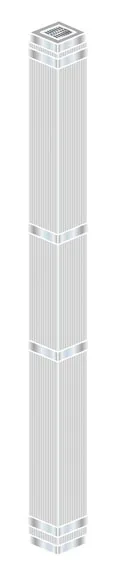
Nuclear fuel consists of a series of cylindrical ceramic pellets of uranium oxide, whose U-238 is enriched to a variable degree (up to 5%) with U-235. These are encased in zirconium alloy tubes to create fuel rods, which are arranged into a structure to form the fuel assembly.

Since it is in the reactor, the uranium and other radionuclides generated are subject to neutron capture and nuclear fission reactions, resulting in fission products, activation products and the generation of plutonium and minor actinides. The composition of these products includes virtually every element of the periodic table.

Quantities and characteristics of the components of the irradiated fuel depend on its initial U-235 enrichment, its degree of burnup and the operation of the reactor.

Infografia de un elemento combustible

Fuel assembly model

Expected generation

In order to estimate the future generation, a series of hypothesis and the reference scenario considered in the General Radioactive Waste Plan must be taken into account.

Reference Scenario

  • Open Fuel Cycle; that is, the reprocessing option for spent fuel is not considered.
  • Lifetime of NPPs in operation, with a working rhythm similar to the current one, according to the following reference scenario for the cessation of operation:
Table with the lifetime of NPPs in operation, where reactors are identified, and the dates of beginning and ceasing operation are shown.
Reactor Date of beginning operation Date of ceasing operation
Almaraz I 01/09/1983 11/2027
Almaraz II 01/07/1984 10/2028
Ascó I 10/12/1984 10/2030
Ascó II 31/03/1986 09/2032
Vandellós II 08/03/1988 02/2035
Trillo 06/08/1988 05/2035
Cofrentes 11/03/1985 11/2030
  • To make the calculation for dismantling wastes, we consider 10 years for the dismantling of each NPP, except for Vandellós I where 15 years are considered from 2030.
  • Total dismantling of the NPPs that are currently in operation, to begin 3 years after their definitive shutdown.
  • The period between the definitive shutdown and the beginning of the dismantling is included in the operational phase for the purposes of waste generation.
  • In the case of radioactive facilities, the estimate for waste generation is elaborated according to the waste treatment done in C.A. El Cabril.
  • The prevision of wastes to be managed coming from expected facilities for spent fuel, HLW and SW management, as Decentralized Temporary Storage (DTS) and the Deep Geological Repository (DGR) is also considered.

Hypothesis

Hypothesis to calculate estimates in operational phase

  • Estimates proposed for the annual generation are done according to the NPPs yearly previsions of generation for the next five years.
  • The estimate for VLLW and LILW is calculated considering the volume of the waste, once conditioned for its final management in C.A. El Cabril.
  • In the case of final disposal for spent fuel, we have considered for its quantification DGR capsules.
  • For special wastes, their final disposal is in capsules similar to the ones used in José Cabrera NPP dismantling (GWC).
  • For all streams and types of waste, a range of uncertainties are considered: 15% for VLLW/LILW, 50% for SW, between 10 and 30 elements for spent fuel.

Hypothesis to calculate estimations in dismantling phase

  • For NPPs PWR type (Ascó I and II, Almaraz I and II, Vandellós II, Trillo), very similar in their designs, the amount of wastes to be generated is defined in a detailed study developed for Vandellós II NPP.
  • According to the operational experience of José Cabrera’s dismantling, for other NPP’s dismantling projects we make an estimate of the secondary wastes generation (compactable material, ventilation filters, etc.), of the volume of special waste expected to be managed, of the rejected material from the releasing process (radioactive material that, after its measure, does not comply with the criteria defined and approved by the CSN for releasing), and also of the conditioning of the wastes according to the type and container.
  • In the case of concrete, we consider the scarification treatment that will be applied to contaminated surfaces, depending on its radiological classification.
  • For contaminated soils we use as a reference the estimate done for José Cabrera NPP, considering between 30-60% as VLLW and the rest as releasing material.
  • For each NPP we get a maximum and a minimum inventory, depending on the uncertainties, which depends on the type of NPP, on the percentage of decontaminated soils, on the amount of secondary wastes generated and on the filling percentage of the final containers corresponding to each type of waste.

Total inventory at 31st December 2022

Considering all the uncertainties and hypothesis previously explained, estimates of the inventory for each type of waste, are shown below:

Table that shows the inventory at 31/12/21 by type of waste (VLW, LILW, SW, SF and HLW), the expected generation at that date, and the total inventory giving a maximum and a minimum value, in m³.
Type of waste Estimated volume (m3)
Inventory at 31/12/22 Expected generation Total inventory
VLLW 31.300 93.700 125.000
LILW 41.100 53.100 94.200
SW 200 200 200
SF and HLW 8.900 2.500 11.400
TOTAL 81.500 153.000 234.500

This implies that, at inventory date, 35% of the radioactive wastes expected are already generated. According to the estimates of the total inventory, considering the average value, the distribution related to the type of waste is as follows:

Inventario total

Table that reflects the distribution of the total inventory accoridng to the origin of the wastes.
Inventory VLLW LILW SF/HLW SW TOTAL
Operation of NPPs 11.600 40.300 11.400 200 63.500
Dismantling of NPPs 91.000 46.500 700 138.200
Juzbado 1.000 100 1.100
Ciemat, DTS/DGR, El Cabril/others 21.400 7.300 3.000 31.700
TOTAL 125.000 94.200 11.400 3.900 234.500
According to the average value for the total inventory (234,500 m³), 63,390 m³ come from the operation of the NPPs, 137,400 m³ from the dismantling of NPPS, 1,300 m³ from the nuclear fuel manufacturing facility “Juzbado” and 32,410 m³ from Ciemat, Cabril, DTS, DGR and others.